




Not long ago, artificial intelligence in healthcare felt like a future promise, something experimental, discussed more in conferences than used in daily practice. That’s no longer the case.
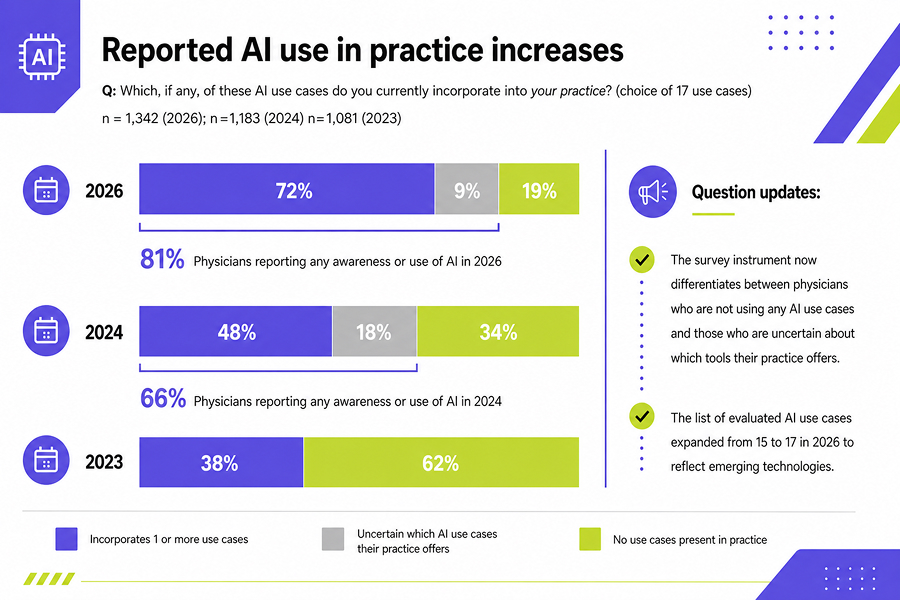
Today, AI is quietly becoming the backbone of efficient healthcare operations. The American Medical Association reports that more than 80% of physicians now report using AI in their professional workflows, a figure that has doubled in just a year. And it’s not just occasional use — clinicians are relying on AI across multiple tasks, from documentation to diagnosis.
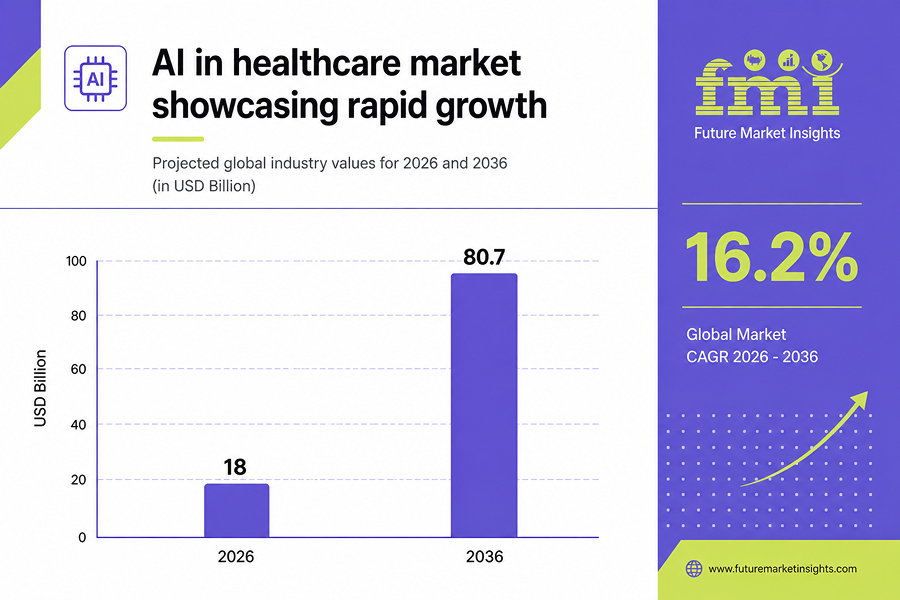
This shift is mirrored by rapid market growth. The global AI healthcare market is expected to scale from $18 billion in 2026 to over $80 billion by 2036, driven by very real pressures: staff shortages, increasing patient demand, and the need for faster, more accurate decisions.
What’s important here is not the technology itself but what it enables. AI is helping healthcare systems move from reactive to proactive care, from fragmented data to connected insights, and from manual processes to more efficient and scalable operations.
In this article, we’ll look at how is AI used in healthcare today and where it creates the most practical value.
What is AI in healthcare
In simple terms, AI in healthcare refers to the use of machine learning algorithms, natural language processing, and other AI technologies to analyze complex medical data and assist in decision-making.
That is one of the most important benefits of AI in healthcare: the systems can process vast amounts of information and identify patterns that might otherwise go unnoticed by humans. For instance, an AI model can analyze thousands of medical images in seconds and detect subtle abnormalities that could indicate early-stage diseases.
Importantly, AI does not function independently. Instead, it works alongside healthcare professionals, providing insights and recommendations that support clinical decisions.
AI solutions in healthcare
If you zoom out, artificial intelligence in healthcare is a layered ecosystem embedded into clinical workflows, data infrastructure, and decision-making processes. The real value comes not from individual features, but from how these systems connect data, context, and action across the patient journey.
Let’s walk through the core AI healthcare software development solutions from a more expert lens.
How AI is used in healthcare from frontline care to research
AI in triage and diagnostics
One of the earliest and most impactful uses of AI is at the entry point of care, triage, and diagnosis. AI systems can quickly analyze symptoms, patient history, and clinical data to prioritize cases and flag potential conditions.
This is particularly valuable in high-pressure environments like emergency departments, where speed and accuracy are critical. In diagnostics, AI is also transforming radiology and pathology by identifying patterns in imaging data that may be missed by the human eye. As a result, clinicians can make faster, more informed decisions and reduce diagnostic errors.
Tools used in the market:
- Infermedica
- Ada Health
- K Health
- Aidoc
- Zebra Medical Vision
AI in patient monitoring
Beyond the hospital, AI is redefining how patients are monitored over time. Instead of episodic care, healthcare providers can now rely on continuous data streams collected from wearables and remote monitoring devices.
This allows for early detection of deterioration, especially in patients with chronic conditions. Subtle changes in vital signs — often invisible during routine checkups — can trigger alerts and enable timely intervention. Consequently, this reduces hospital readmissions and supports the shift toward remote and home-based care models.
Tools used in the market:
- Current Health
- Feebris
- Biofourmis
- Philips HealthSuite
AI in patient treatment and personalization
AI is also playing a bigger role in shaping treatment decisions. By analyzing large datasets — like clinical records, lab results, and genetic information — AI can help identify the most effective therapies for individual patients.
This is especially important in fields like oncology, where treatment responses vary significantly. AI enables a more personalized approach, moving away from one-size-fits-all medicine toward precision care. At the same time, it supports clinicians with evidence-based recommendations, reducing uncertainty in complex cases.
Tools used in the market:
- Tempus
- IBM Watson Health (Merative)
- PathAI
- Guardant Health
AI in administrative workflows
While clinical applications often get the spotlight, one of the most immediate benefits of AI lies in administrative efficiency. Healthcare systems are burdened with documentation, scheduling, billing, and compliance tasks that consume a significant portion of clinicians’ time.
AI helps automate these processes, reducing manual input and minimizing errors. As a result, healthcare professionals can spend more time with patients rather than on paperwork.
Tools used in the market:
- Nuance DAX (Microsoft)
- Olive AI
- Suki AI
- Notable Health
AI in data analytics and decision support
Healthcare generates enormous volumes of data, but without the right tools, much of it remains underutilized. AI changes this by connecting and analyzing data across systems, uncovering patterns that support better clinical and operational decisions.
From predicting patient risk to optimizing hospital resource allocation, AI-driven analytics provides actionable insights in real time. This not only improves patient outcomes but also helps healthcare organizations operate more efficiently in increasingly complex environments.
Tools used in the market:
- Epic (AI modules)
- Oracle Health (Cerner)
- Health Catalyst
- SAS Health
AI in research and drug development
Traditional drug discovery is time-consuming and costly, often taking years before reaching clinical trials. AI accelerates this process by identifying promising compounds, simulating outcomes, and optimizing trial design.
This significantly reduces both time and cost, while increasing the likelihood of successful outcomes. In addition, AI enables researchers to analyze complex biological data at a scale that was previously impossible, opening the door to new medical breakthroughs.
Tools used in the market:
- Insilico Medicine
- BenevolentAI
- Atomwise
- Recursion Pharmaceuticals
Real-life examples of AI in healthcare solutions
To understand the real impact of AI in healthcare, it’s helpful to look at how it is already being applied in practice
AI in diagnostics: improving epilepsy detection accuracy
A recent study published in JAMA Neurology shows how AI can significantly improve the detection of brain abnormalities that are often missed in standard clinical practice. Researchers developed a graph neural network model that analyzes MRI scans to identify focal cortical dysplasia — a common cause of epilepsy that is notoriously difficult to detect.
The results are compelling: the AI system was able to detect up to 64% of lesions that radiologists had previously missed, while maintaining a strong level of accuracy.
AI in drug discovery: the case of drug Rentosertib
A recent milestone in AI-driven healthcare is the drug Rentosertib, developed by Insilico Medicine. What makes it unique is that both the biological target and the drug molecule itself were discovered using AI — something that hasn’t been done before at this level.
The drug is being developed to treat idiopathic pulmonary fibrosis (IPF), a serious lung disease with limited treatment options.
Using generative AI, researchers were able to analyze large biological datasets, identify a new therapeutic target (TNIK), and design a molecule to act on it much faster than traditional methods. What’s especially important from a business perspective is the speed and efficiency. The AI-driven approach reduced early drug discovery timelines to around 18 months, compared to several years in traditional pharma.
AI agents in healthcare : patient communication and care coordination
AI is also being applied in everyday patient interactions. Hippocratic AI is an example of a new generation of AI agents designed specifically for healthcare. It focuses on patient-facing interactions, such as follow-up calls, care coordination, and answering routine medical questions.
Unlike general-purpose AI assistants, it is built with a strong emphasis on safety, reliability, and clinical accuracy and is designed to handle non-diagnostic tasks in real healthcare environments.
Benefits of AI in healthcare
Improved diagnostic accuracy
In everyday practice, AI works as a second layer of review. It scans medical images and patient data using trained models, then highlights what might need attention. As a result, clinicians can catch conditions earlier and reduce variability between decisions without changing how they already work.
Increased efficiency and productivity
At the same time, AI removes much of the routine work that slows healthcare down. It can draft notes, support coding, and optimize scheduling. Consequently, processes move faster, errors decrease, and clinicians can spend more time on actual care instead of admin tasks.
Early disease detection
Rather than waiting for symptoms to escalate, AI looks at trends over time. By analyzing labs, vitals, and patient history together, it can flag risks earlier. This allows care teams to intervene sooner, often preventing complications and reducing emergency cases.
Personalized treatment plans
AI helps narrow down treatment options based on what is most likely to work for a specific patient. By combining clinical data with broader medical knowledge, it supports more targeted decisions, making care both more precise and more effective.
Cost reduction
AI reduces unnecessary steps in the system. Fewer duplicate tests, better care planning, and lower readmission rates all contribute to cost savings. Importantly, this comes from improving efficiency, not reducing the quality of care.
Enhanced patient experience
From the patient’s perspective, AI simplifies the journey. Faster responses, better communication, and more coordinated care reduce frustration. As a result, patients feel more informed, supported, and engaged throughout treatment.
Challenges of AI in healthcare
Data privacy and security concerns
To begin with, AI in healthcare depends on massive volumes of highly sensitive patient data, from EHRs to imaging and genomics. This creates a constant tension between innovation and protection. As a result, organizations must invest in encryption, access control, and strict compliance with regulations like GDPR and HIPAA, because even a single breach can quickly erode trust.
Bias in AI models
At the same time, AI systems are only as reliable as the data they learn from. If training datasets lack diversity, AI models may produce skewed or incomplete outcomes. Consequently, certain patient groups may receive less accurate recommendations. This is a serious clinical and ethical concern that requires continuous monitoring and improvement.
Lack of standardization
Meanwhile, healthcare data remains fragmented across systems. Different EHR vendors, formats, and interoperability gaps make integration complex. Standards like HL7 and FHIR aim to address this, but adoption is uneven. As a result, scaling AI solutions across institutions remains a technical and operational challenge.
Regulatory and compliance issues
In addition, AI software in healthcare must meet strict regulatory requirements (FDA, MDR in Europe). Clinical validation, auditability, and explainability are essential but time-consuming. This creates a gap between innovation speed and approval timelines, slowing real-world deployment.
Resistance to adoption
Many clinicians remain cautious about relying on AI, especially when models lack transparency. Furthermore, if tools disrupt existing workflows or require extra effort, adoption drops. Therefore, successful implementation depends on usability, proper training, and aligning AI with how healthcare professionals actually work.
High implementation costs
Finally, the financial barrier cannot be ignored. Implementing AI requires more than just software. It involves infrastructure, integration, and specialized talent. In the short term, these costs can be significant, particularly for smaller providers. Although the long-term value is promising, the initial investment often slows down adoption and limits accessibility.
H2: Wrapping up
So, what does all of this really come down to?
Artificial Intelligence in healthcare is no longer something experimental. It’s already part of everyday practice. It’s helping clinicians catch issues earlier, reduce administrative burden, and make faster, more informed decisions.
That said, success with AI isn’t about using it everywhere. It’s about using it where it matters, whether that’s saving time, improving accuracy, or simplifying complex workflows.
Of course, there are still challenges. Data privacy, system integration, and adoption don’t happen overnight. But these are part of the process, not reasons to hold back.
In the end, AI isn’t replacing healthcare professionals. AI supports them. And the organizations that learn how to use it effectively will be better positioned to deliver more efficient and high-quality care.


.png)


