



If you've experimented with AI over the past two years, you've probably had the same experience as everyone else.
The model can write emails. It can summarize documents. It can generate meeting notes.
But the moment you ask something specific about your business — which customers are most likely to churn, why inventory shortages keep happening, or what projects are at risk of delay — you can’t get anything useful out of it.
Not because the AI is bad.
Because it doesn't know anything about your company.
Your CRM, ERP, internal documentation, ticketing systems, inventory databases, and communication platforms contain the information that drives business decisions. Yet in many organizations, AI never gains reliable access to those systems to help with decision-making.
As a result, many companies discovered that their expensive AI initiatives were functioning more like glorified copywriting assistants than operational business tools.
The challenge wasn't the AI itself — it was connecting AI to the systems that make your business unique.
And until recently, that connection was often expensive, fragile, and difficult to maintain.
This is where Model Context Protocol (MCP) changes the equation of agentic AI development.
You got your AI deployed, but you’re not out of the woods yet
When organizations become disappointed with AI results, they often assume the technology itself is overhyped.
In reality, the limitation is usually much more practical.
Most AI deployments operate in isolation from the business systems where valuable information actually lives. The model can access public knowledge, but it cannot see customer records, project data, inventory levels, or service histories.
Without that context, even the most advanced model can only provide generic answers.
This explains why many AI pilots deliver strong results during demonstrations but struggle to create lasting operational value. The technology works exactly as intended — it simply lacks access to the information required to make business-specific decisions.
As a result, modern AI development services increasingly focus on integration rather than model selection.
The question is no longer which LLM to use. The question is how to connect that model to the systems where your business knowledge resides.
What is Model Context Protocol?
Here’s a real-world analogy if you don’t want to get in the weeds of software engineering mechanics: the global shipping industry.
Before the 1950s, cargo was loaded onto ships piece by piece in sacks, crates, and barrels. It was incredibly slow and labor-intensive, and the products were prone to damage. On top of that, every port had different handling standards.
The industry was transformed by the introduction of the standard intermodal shipping container. It did not matter what was inside the container — electronics, clothing, or raw materials — and it did not matter which crane or ship handled it. The dimensions were identical everywhere. Shipping became modular, cheap, and lightning-fast.
MCP is the shipping container standard for the AI era.
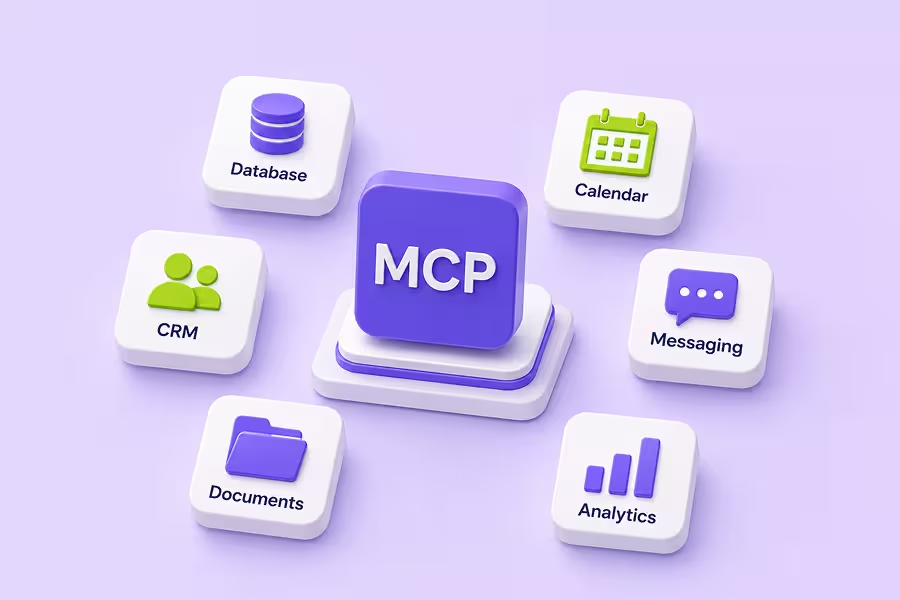
Developed by Anthropic as an open-source protocol, Model Context Protocol (MCP) establishes a standardized way for AI systems to access business data and software tools. At the center of the MCP architecture sits the MCP server — a reusable layer that connects AI applications to internal systems, databases, APIs, and business software without requiring a custom integration for every use case.
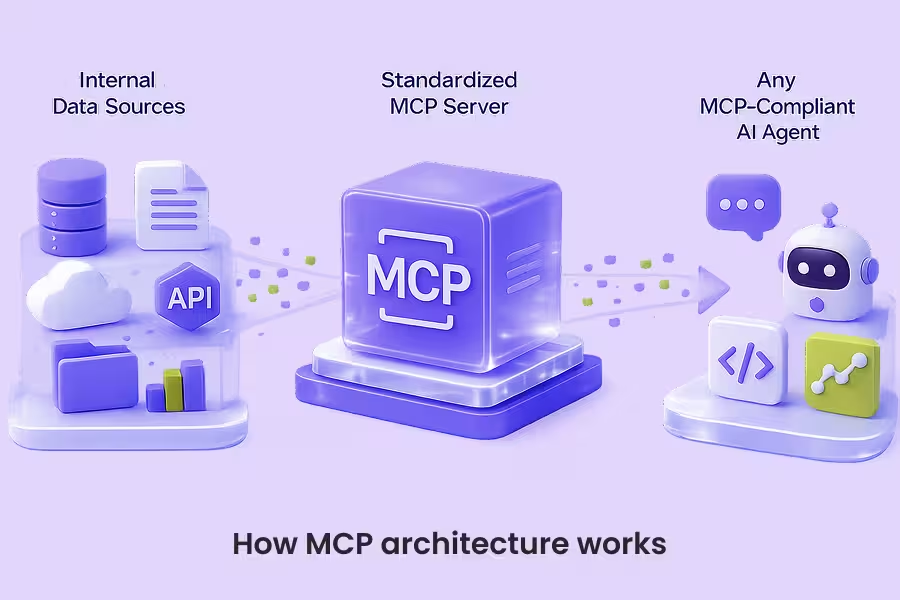
MCP architecture in practice
In a typical MCP architecture, business systems expose data through an MCP server while AI applications consume that information through a standardized interface. Whether you're connecting customer records, inventory databases, internal documentation, or third-party SaaS platforms, the same MCP integration pattern applies across the stack.
Why does that matter?
Because one of the biggest obstacles to useful AI has never been the model itself. It's been the effort required to connect that model to the systems where your business knowledge actually lives.
Without a common standard, every new AI initiative risks becoming a custom integration project. Your team builds one connection for the CRM, another for the ERP, another for internal documentation, and then repeats the process when a new AI model or framework enters the picture.
MCP replaces that approach with a reusable layer.
Instead of building a new bridge every time you introduce a new AI tool, your team can expose a data source through MCP once and make it available to any MCP-compatible application or agent. The result is less custom development, lower maintenance overhead, and a much faster path from AI experimentation to real operational use cases.
The AI model no longer needs to understand the quirks of your internal systems. It simply requests the information it needs through a standardized interface, while your business data remains in the systems where it already belongs.
MCP integration benefits: low cost, high impact
Essentially, MCP is a hassle-free way to plug data sources into an LLM. And while we all love everything hassle-free, the benefits of MCP go much further than that.
1. Effortless MCP implementation
With MCP, your engineering team builds a single MCP server around an internal data source. Once the MCP implementation is complete, that data source can be accessed by multiple AI applications and MCP AI agents without rebuilding the integration layer.
2. Reduced maintenance costs
Because MCP operates on a standard protocol, it eliminates the endless cycle of integration debugging. If your internal data schema changes, your developers only update the local MCP server configuration. The downstream AI applications require zero code changes to continue functioning, preventing unexpected system downtime.
3. Future-proof flexibility
The AI marketplace is moving too quickly for rigid infrastructure. Models that lead the market today may be replaced by faster, cheaper alternatives within six months. But because MCP decouples the data source from the intelligence layer, you can swap out the underlying LLM at any time without rebuilding your data connections.
4. Secure, contextual data access
If you were to try to plug your data into an AI model the old way, you would have to move large volumes of sensitive corporate knowledge into vector databases or external cloud environments for indexing. That creates another layer of security and compliance issues.
MCP takes a different approach. It allows the AI agent to query data securely in real time, pulling only the precise context required to complete a specific task. Your data stays exactly where it belongs, fully compliant with your existing governance frameworks.
How industries can benefit from MCP-enabled AI
The MCP benefits sound good on paper, but let’s put them into the perspective of a real business and see how much value they bring in.
MarTech and e-commerce platforms
An AI agent leveraging MCP can simultaneously look at customer behavioral logs from a web store, current stock levels from an inventory database, and historical campaign data from a marketing automation suite. It can then generate hyper-personalized re-engagement campaigns that are accurate down to real-time unit availability.
ConstructionTech and field operations
For field-heavy industries where data flows from mobile reporting apps, drone telemetry, and legacy asset management systems, MCP allows an AI agent to easily synthesize disparate inputs. Executives get accurate project delay predictions based on fragmented field logs without paying for massive data consolidation projects.
Healthcare and FinTech
MCP serves as a secure gateway for highly regulated markets where data compliance is strict. Instead of exposing entire healthcare or financial records to a model, the protocol acts as a strict compliance filter: this way, AI agents pull anonymized, contextual variables to assist with billing audits or regulatory reporting safely.
Ultimately, MCP transforms data integration from a costly engineering bottleneck into a reusable asset that directly lowers your total cost of ownership on your AI. It shifts the executive focus away from high pipeline maintenance overhead and toward the efficient workflow automation through secure AI agents.
Your signal to take another look at AI
For many organizations, the first generation of AI adoption delivered an important lesson.
The models themselves were rarely the limiting factor.
The real obstacle was the cost and complexity of connecting those models to internal business systems.
Every new use case required another integration project. Every new data source introduced additional maintenance overhead. Every platform change created another dependency for engineering teams to manage.
As a result, many companies concluded that AI was useful for content generation but impractical for core operations.
MCP significantly lowers that barrier.
By introducing a reusable standard for connecting AI systems to business data, it turns integration from a recurring engineering project into a repeatable process. Organizations can connect internal knowledge sources once and reuse them across multiple AI initiatives instead of rebuilding the same foundations over and over again.
That changes the economics of AI implementation.
The conversation shifts away from "Can we afford to build another integration?" and toward "Which business process should we improve next?"
If your previous experience with AI left you unconvinced, it may be worth taking another look.
The competitive advantage won't come from simply using AI. It will come from giving AI access to the information that makes your business unique.
MCP makes that goal significantly more achievable than it was even a year ago.
Standardized path to operational AI
Many businesses have already experimented with AI and discovered the same limitation: the models can generate content, but they don't understand the business.
The problem is rarely intelligence. It's access to context.
Model Context Protocol offers a practical way forward. By standardizing how AI systems connect to business tools and data, MCP reduces the integration effort that has traditionally slowed AI adoption and turned simple initiatives into expensive engineering projects.
The companies that gain the most value from AI won't necessarily be the ones using the newest models. They'll be the ones that connect those models to their unique business knowledge most effectively.
For organizations that dismissed AI as an advanced copywriting tool, MCP may be the development that makes it worth a second look.


.png)


