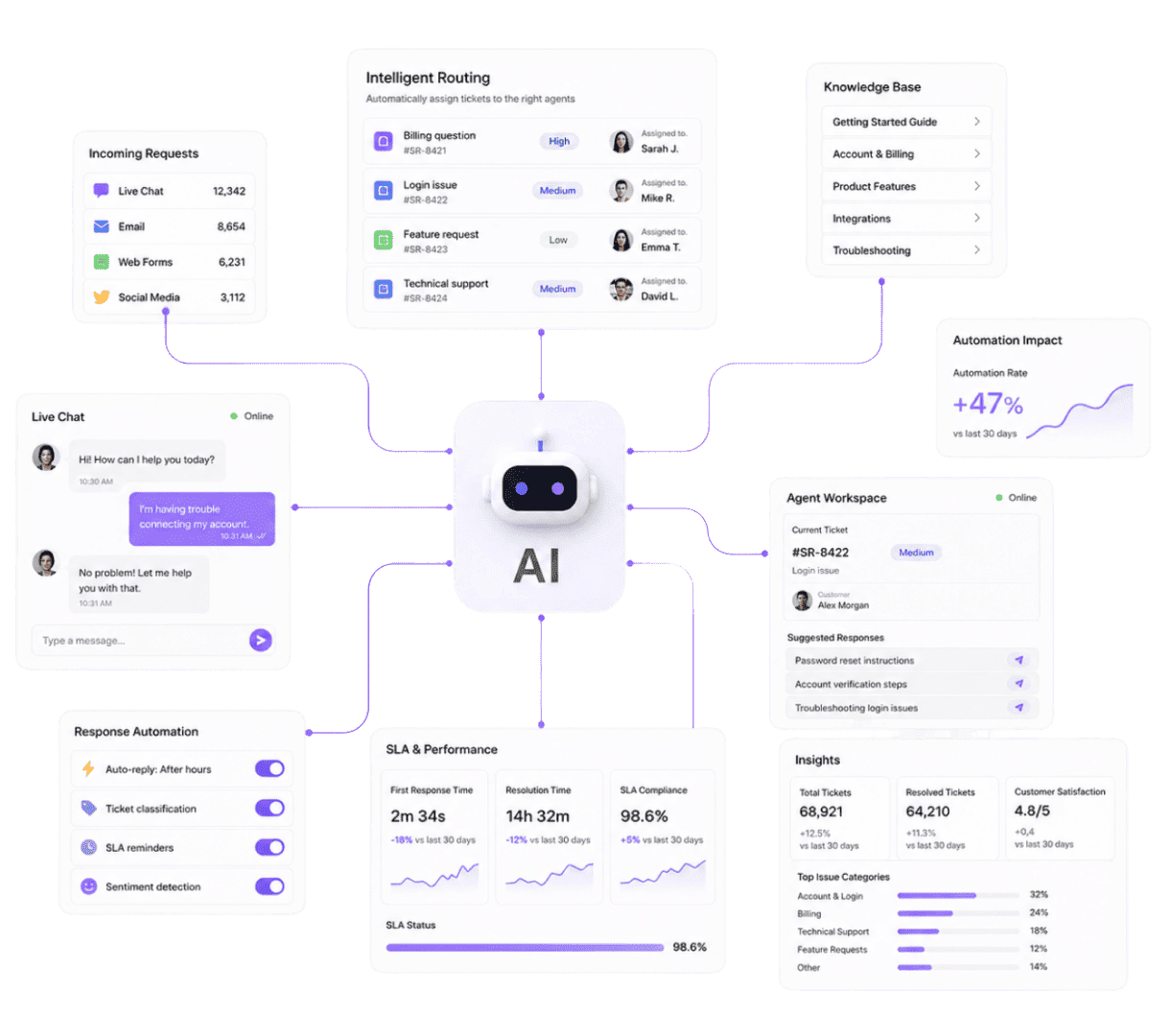
AI customer support platform helps businesses automate workflows and reduce agent load.AI customer support platform helps businesses automate workflows and reduce agent load.
Home
|
Portfolio
|
AI-Powered Customer Support System

Building Scalable AI Customer Support with RAG

We deployed an AI-driven support ecosystem using RAG and automated workflows for a high-volume SaaS platform, reducing agent load and stabilizing infrastructure to achieve 99.9% uptime and consistent SLA compliance.

AI-powered customer support system:
TsNavMenu

About the client

The client is a mid-size SaaS provider specializing in high-volume customer service platforms. Their infrastructure manages over 100,000 monthly support requests, serving as a mission-critical tool for businesses that require real-time ticket resolution and strict SLA adherence.
Country:
USA
Industry:
Real estate and construction
Duration
March, 2022 – ongoing
Model:
B2B, B2C
Team size:
1 project manager, 5 front-end developers, 10 back-end developers, 7 mobile developers, 3 DevOps, 12 QA engineers, 1 designer
Key technologies:
React, Java, MobX
See all

Client’s challenge

As the client’s user base expanded, their legacy infrastructure struggled to handle the increased load. The system faced high agent burnout, significant response delays, and rising operational costs. Frequent downtime and service volatility began to erode user trust and jeopardize SLA compliance.

The primary technical and operational hurdles included:
  • Persistent downtime and service volatility as a result of inconsistent architecture
  • Manual ticket routing and repetitive queries that hindered scalability
  • Inefficient resource allocation that didn't scale linearly with user growth
  • Cumbersome release process that delayed critical feature delivery and bug fixes

Solution

We transitioned the support ecosystem from a manual, reactive model to a proactive, AI customer service platform. The solution focused on offloading high-frequency tasks to intelligent agents while stabilizing the underlying delivery pipeline.

AI agents with RAG for smarter, scalable support

We implemented AI agents powered by RAG to process incoming requests in real-time. By leveraging the client’s internal knowledge base and historical data, the model provides customers with accurate contextual responses. To ensure service quality, we built an automated escalation logic that hands off complex or sensitive cases to human operators.

Workflow optimization & message queuing

To resolve latency and system friction, we re-engineered the backend workflow. This included automating the routing and escalation logic and redesigning the message queue and response chain. These optimizations make interactions trackable, and the system remains responsive even during peak traffic.

Stability via CI/CD and monitoring

To ensure long-term reliability, we established automated continuous integration (CI) pipelines and comprehensive system monitoring. Every release now undergoes automated testing to guarantee quality and shorten delivery cycles, allowing for 99.9% uptime and dependable performance under heavy loads.

Technologies

Backend

Apache Kafka
AWS BedRock
FastAPI
PostgreSQL
Python
Temporal Workflow

Process

We understood that the challenge wasn't just adding AI but ensuring the system could handle high volumes of data without failure.

1. Workflow alignment & system audit

Our engineering team collaborated with the client’s product stakeholders to audit existing support ticket lifecycles. We mapped the journey of a request from intake to resolution, identifying architectural bottlenecks in the message queue and manual routing gaps to define a more efficient data environment.

2. Prototyping & RAG validation

Before full-scale integration, we developed a proof of concept to validate the RAG model’s accuracy. We tested the AI against historical support logs to refine its ability to pull correct data from the internal knowledge base, ensuring it could handle niche technical queries before automating live customer interactions.

3. Project management routine

Throughout the engagement, we integrated our workflows into the client’s ecosystem using shared Jira and Confluence spaces. We maintained real-time transparency via Slack and established a routine of daily check-ins and bi-weekly demos. This allowed stakeholders to review functional builds and technical documentation in sync with their internal roadmap.

1. Workflow alignment & system audit

Our engineering team collaborated with the client’s product stakeholders to audit existing support ticket lifecycles. We mapped the journey of a request from intake to resolution, identifying architectural bottlenecks in the message queue and manual routing gaps to define a more efficient data environment.

2. Prototyping & RAG validation

Before full-scale integration, we developed a proof of concept to validate the RAG model’s accuracy. We tested the AI against historical support logs to refine its ability to pull correct data from the internal knowledge base, ensuring it could handle niche technical queries before automating live customer interactions.

3. Project management routine

Throughout the engagement, we integrated our workflows into the client’s ecosystem using shared Jira and Confluence spaces. We maintained real-time transparency via Slack and established a routine of daily check-ins and bi-weekly demos. This allowed stakeholders to review functional builds and technical documentation in sync with their internal roadmap.
go
go

Deliverables

01
RAG-based AI agent integration
02
Automated ticket routing engine
03
Backend architecture redesign
04
Message queue optimization
05
CI/CD pipeline implementation
06
Real-time system monitoring dashboard
07
Automated QA and regression testing
08
Comprehensive technical documentation

Results

The engagement transformed a volatile support platform into a stable, AI-driven system capable of scaling with demand. By automating high-frequency interactions and optimizing the backend, we significantly decreased the burden on human operators and stabilized uptime during traffic surges.
The client now maintains 99.9% availability, ensuring high customer satisfaction and reliable SLA compliance.
60
%
of requests are resolved without humans
0
s
response time with instant AI replies
7
min
average resolution time
35
%
infrastructure costs decrease
30
s
system latency decrease

Similar case studies