About the client

Client’s challenge
For this client, clinical data processing was an area where software could support that objective. Large volumes of data and complex data management activities needed to be handled efficiently, with opportunities to automate workflows and run suitable steps in parallel.
The challenge was the balance: make the operations more efficient while preserving the data integrity and security. Faster processing would have limited value if researchers could not reliably access the information relevant to their work.

- Competitive pressure to optimize medicine development timelines
- Complex processing of large clinical datasets
- Data integrity and protection requirements across research workflows
- Complex access requirements across research groups and projects
Solution
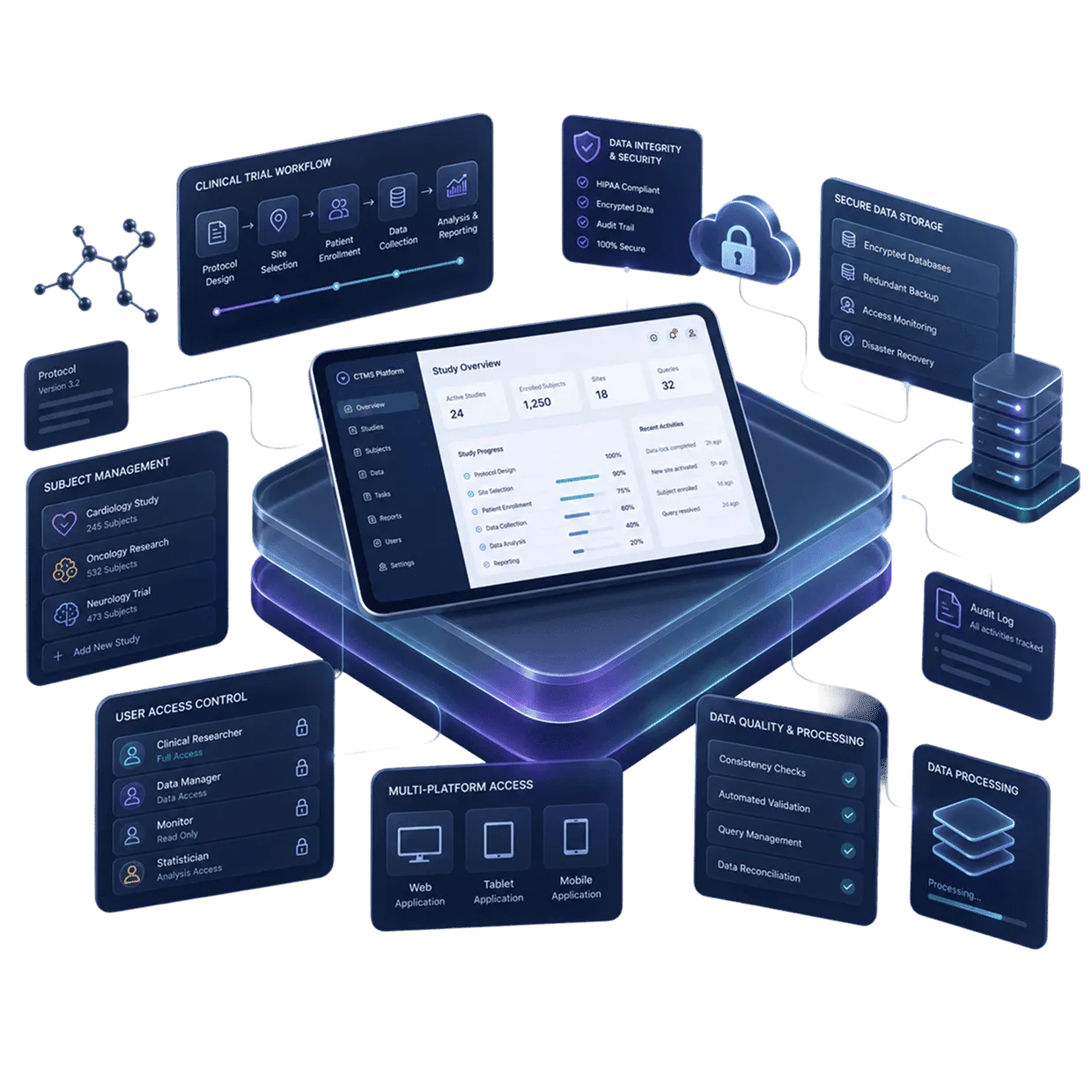
NEKLO delivered a workflow-driven clinical data management platform that combined research data handling, protocol automation, and project-based user organization. Its functionality addressed the relationship between how information was processed, who could access it, and where it belonged within clinical research.

Clinical workflow and protocol automation
We implemented protocol automation to support clinical data management. The solution was designed to reduce avoidable processing delays and enable parallel execution where workflow dependencies allowed it. Automation was built around the requirements governing research data handling, keeping processing efficiency aligned with the client’s operational constraints.

Clinical data management and visibility
The platform supported substantial volumes of clinical data, with visibility across workflow stages. Researchers could access information in the context of their work. By connecting data management with research projects and users, we provided a foundation for organizing information around the activities it supported.

Data integrity and secure handling
We developed functionality supporting data integrity and security during database transfers. Protecting uploaded and stored laboratory information was a core requirement. The scope included HIPAA-related requirements, with data protection addressed alongside workflow automation and accessibility to support efficient processing within the client’s security constraints.

User permissions and research project organization
We implemented access controls and organized users into groups and projects based on research subjects. Permissions governed access to information, connecting data availability with each user’s research responsibilities. This structure supported project-based collaboration, while availability across multiple platforms gave users access through supported environments.
Process
Our approach brought clinical workflow requirements, data management, and access controls into a single development process, keeping the client’s efficiency objectives connected to the needs of its research teams.

1. Clinical workflow and requirements analysis
2. Platform development and workflow automation
3. Data handling and access verification
1. Clinical workflow and requirements analysis
2. Platform development and workflow automation
3. Data handling and access verification

Technologies
Front-end

Back-end


DevOps

Deliverables