




In the current digital landscape, SMS isn’t just a supporting notification tool, but a high-conversion part of the sales funnel. Though email is still a foundational communication channel, it just cannot beat the near-instantaneous engagement of SMS.
And for growing businesses, it’s crucially important to bypass hundreds of unread emails to establish a direct connection with a mobile-first customer base.
Managing dozen of even hundreds of text chains with your entire clientele becomes overwhelming quickly. But one of the most popular solutions to the issue — getting an text message marketing platform set up — isn’t as “plug-and-play” as it seems. Many SMBs find themselves restricted by rigid platforms that fail to scale or legacy systems that lack modern 10DLC compliance and API-first flexibility.
So — we here to help.
This guide provides a technical overview of the top 10 text message marketing software solutions currently on the market. Whether you are migrating from a restrictive SaaS or seeking a partner to help customize your existing setup, in this article you will find everything you need to identify the optimal fit for your business.
Quick comparison: top SMS platforms at a glance
What is SMS marketing software?
Text marketing software is a specialized digital platform that allows businesses to manage, automate, and scale text-based communication with their customers. Unlike personal messaging, these platforms are built for A2P (Application-to-Person) messaging, thanks to which they can deliver high-volume promotional campaigns, time-sensitive transactional alerts, and support two-way conversations within a compliant and trackable framework.
To be considered a true marketing solution, a platform must go beyond simply "sending a text." It typically facilitates three core pillars of modern communication:
- Marketing automation: the ability to trigger messages based on specific user actions, such as abandoned cart reminders, welcome sequences, or post-purchase follow-ups.
- Bulk messaging at scale: efficiently broadcasting messages to large subscriber lists while maintaining high deliverability rates and avoiding carrier spam filters.
- Two-way conversational texting: providing a centralized inbox where sales and support teams can engage in real-time, one-on-one dialogues with customers.
The technical maturity: tools vs. platforms
For many SMBs, the confusion stems from the gap between a basic "texting tool" and robust sms marketing platforms.
A basic tool is often a standalone interface used for manual, one-off blasts. While cost-effective for micro-businesses, these tools often lack deep CRM integrations and sophisticated segmentation.
In contrast, a robust platform acts as a middle-tier in your tech setup. It offers API-first architecture for custom workflows, automated 10DLC (10-Digit Long Code) registration to ensure regulatory compliance, and the ability to sync first-party data across your entire marketing ecosystem.
Choosing the right solution isn't just about the current feature set; you also have to consider the underlying architecture. As your business grows, you have to be sure your platform can handle the transition from simple broadcasts to complex, data-driven customer journeys.
The best SMS marketing software: top 10 picks
Now, to the actual sms marketing tools.
We’ve evaluated the top 10 solutions based on technical maturity, 10DLC compliance, and scalability. This list highlights the best sms marketing platform options for specific operational needs. Use this breakdown to find the architecture that aligns with your tech stack and growth trajectory.
1. Salesmessage
Best for: sales teams and deep CRM integration.
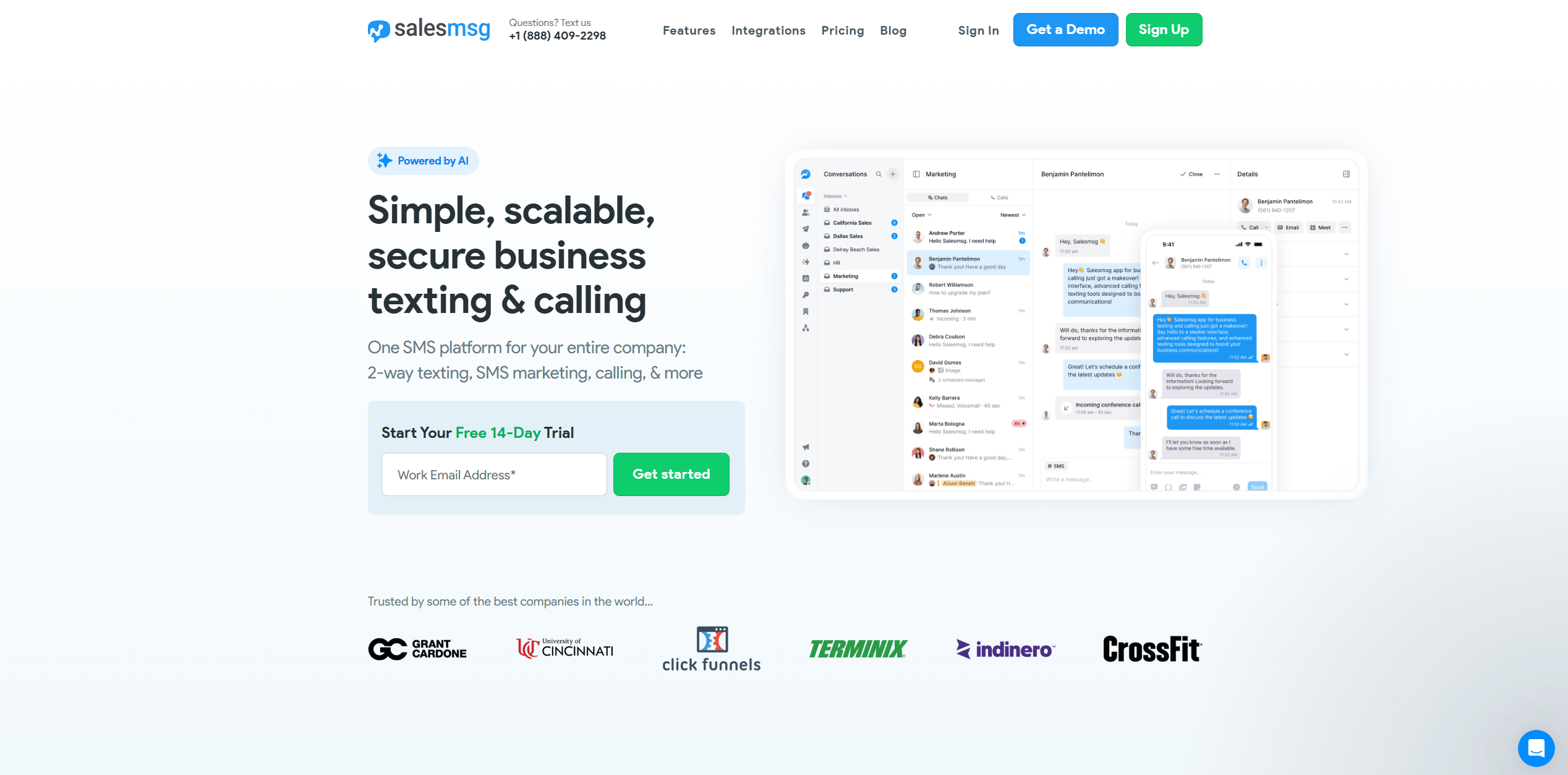
Salesmessage is designed for businesses that view SMS as a core sales and customer engagement channel rather than a broadcast-only tool. It specializes in two-way "conversational" texting, which allows team members to manage high-volume personal dialogues from a centralized dashboard.
Because we work closely with Salesmessage to help build and optimize their applications, we have seen firsthand how their architecture is built specifically to bridge the gap between a messaging app and a professional CRM.
Features and compliance
- Native CRM sync: deep, bi-directional integrations with HubSpot, Salesforce, and Pipedrive.
- 10DLC automation: streamlined registration process to ensure your numbers are carrier-verified.
- Shared inboxes: allows multiple team members to collaborate on the same text thread.
- MMS & Rich Media: Support for images, GIFs, and VCards to personalize outreach.
Pros
- Superior interface for two-way communication.
- Extremely reliable sync with lead management software.
- Excellent mobile app for sales reps on the move.
Cons
- Not the cheapest option for mass "one-way" blast marketing.
- May have more features than a solo practitioner requires.
Pricing
Starts at $25/month (billed annually) for 500 messages. Professional plans with advanced automation and CRM integrations typically start around $49/month.
2. Klaviyo
Best for: data-driven e-commerce brands.
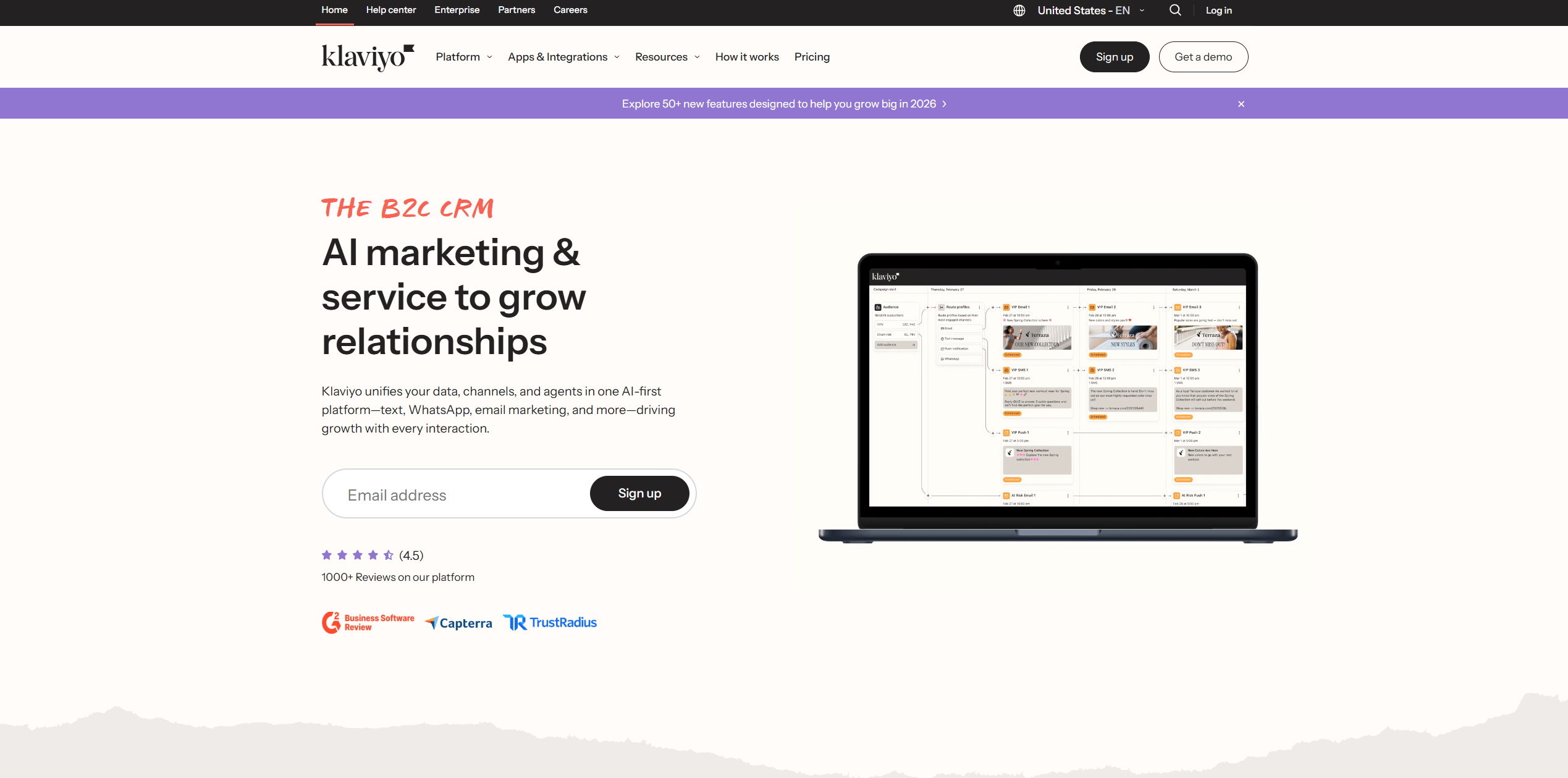
Klaviyo is the market leader for e-commerce businesses that want to unify their email and SMS data. It allows you to create highly segmented flows based on actual purchase history, website behavior, and real-time event triggers. If you are already using Klaviyo for email, adding their SMS service creates a powerful omnichannel engine.
Features and compliance
- Predictive analytics: uses AI to determine the best time to send a text for maximum conversion.
- Shopify & Magento deep integration: automatically triggers messages for abandoned carts, price drops, and back-in-stock alerts.
- Global compliance guardrails: built-in tools for GDPR and TCPA consent management.
Pros
- Unbeatable segmentation capabilities based on first-party data.
- Unified dashboard for both SMS and email marketing.
Cons
- Pricing can escalate quickly as your subscriber list grows.
- Support tiers are often gated behind higher monthly spend.
Pricing
Dynamic pricing based on contact count. There’s a limited free plan, and SMS-only plans start around $15–$20/month, but most SMBs will see costs increase significantly as they scale.
3. SimpleTexting
Best for: SMB all-rounders and ease of use.
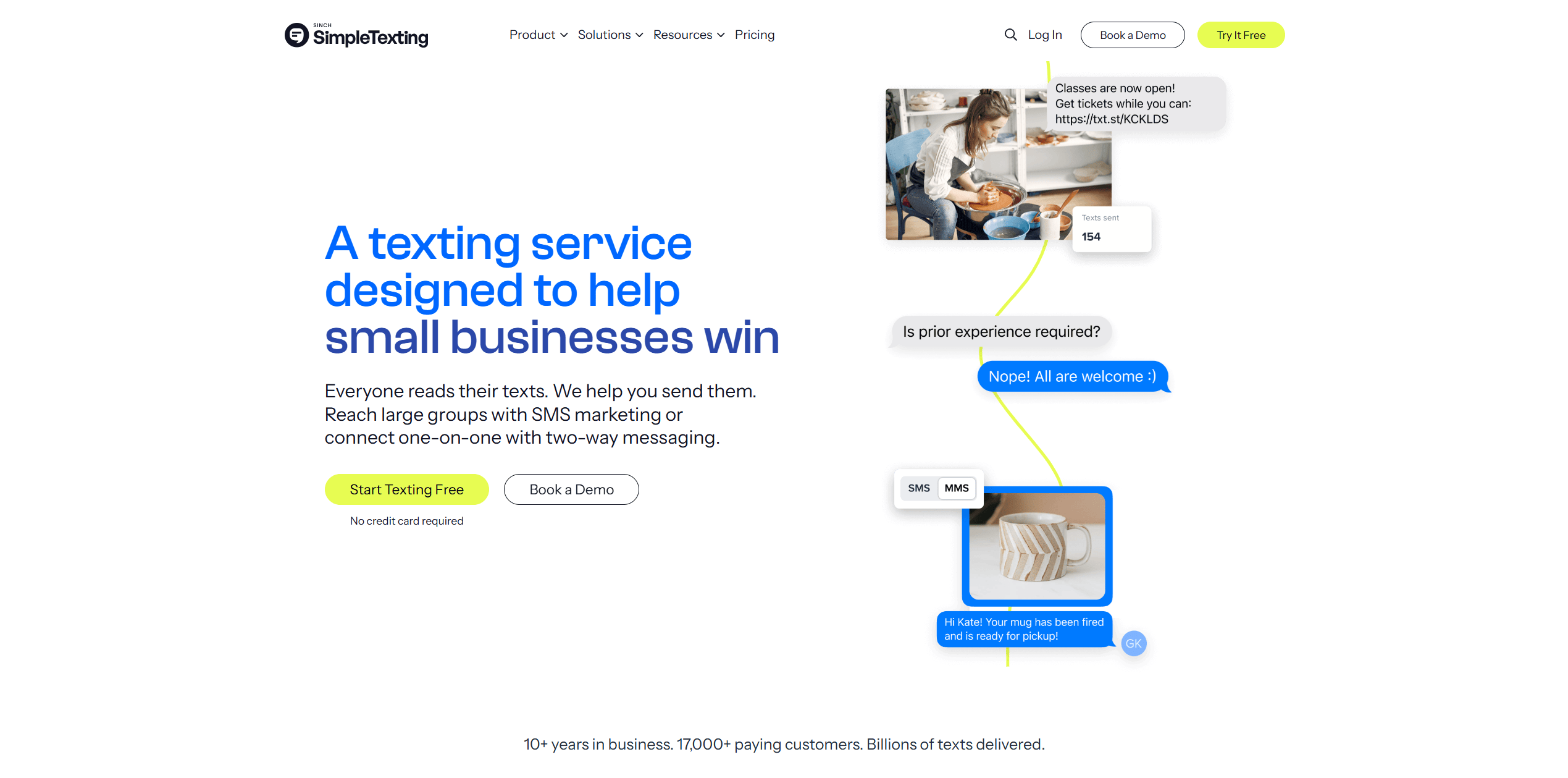
SimpleTexting offers a balanced feature set that appeals to businesses needing both mass promotional blasts and two-way customer support. It is known for its clean, intuitive UI that requires almost no learning curve, making it an ideal choice for teams moving away from basic "texting tools" to a more professional sms marketing platform.
Features and compliance
- Mass texting & scheduling: easy-to-use campaign builder for large-scale promotions.
- AI assist: built-in message generator to help draft copy.
- 10DLC guidance: detailed onboarding to help SMBs navigate carrier registration.
Pros
- Transparent, credit-based pricing.
- Excellent 7-day-a-week customer support.
- Includes 3 user seats even on the starter plan.
Cons
- Limited "rich" automation compared to enterprise platforms.
- Credits do not always roll over on all plan tiers.
Pricing
A free trial is available. Starts at $29/month for 500 credits. High-volume plans scale up to $899/month for 50,000 credits.
4. Attentive
Best for: high-growth brands and enterprise scaling.
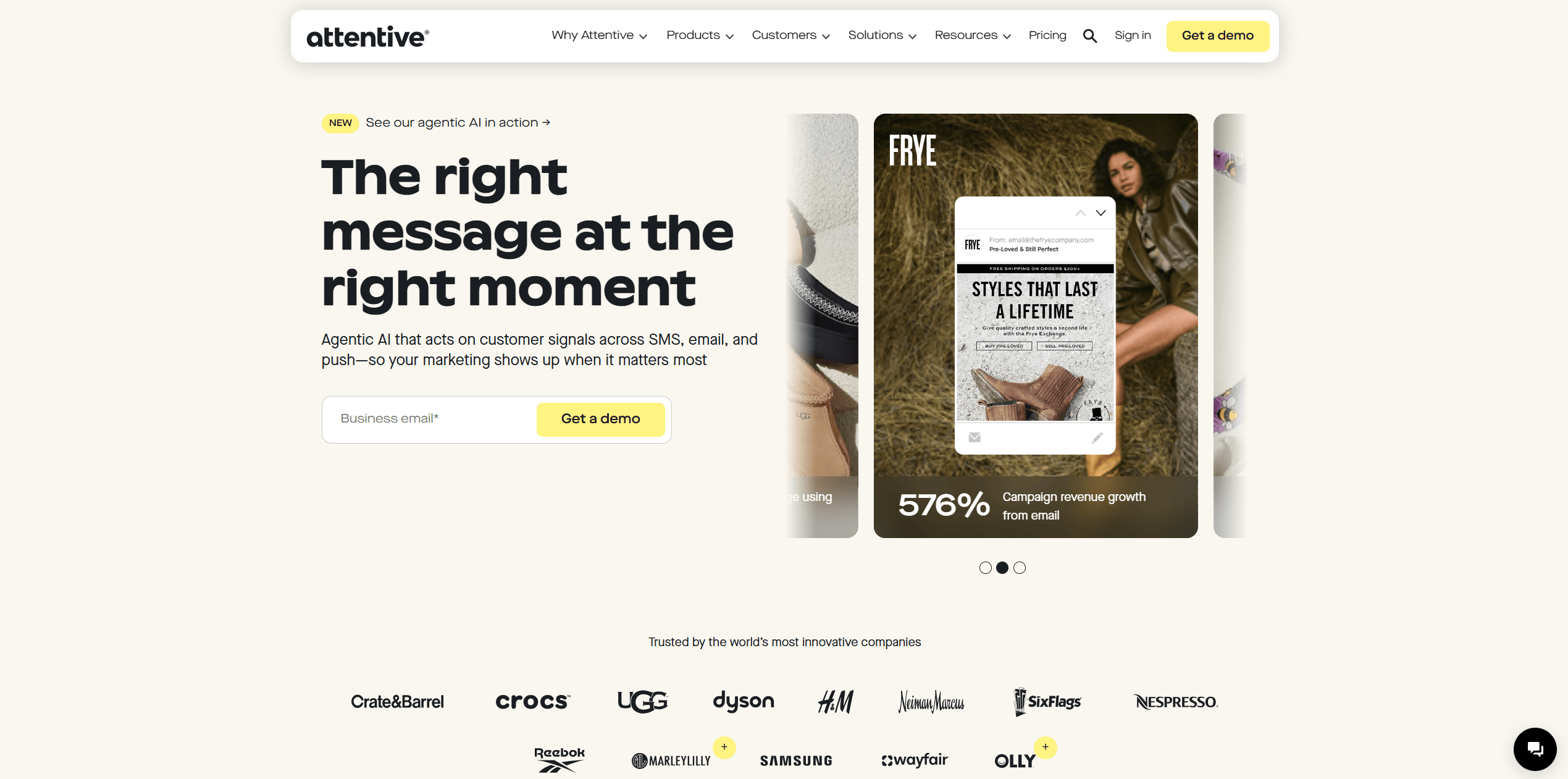
Attentive is built for high-volume retailers who need sophisticated AI-driven personalization. It focuses heavily on maximizing the ROI of every text sent, offering concierge-level services for growing your subscriber list. It is a "heavyweight" platform that works best for businesses with a dedicated marketing budget and high message volume.
Features and compliance
- AI-driven campaign optimization: automatically tests copy and timing to boost click rates.
- Managed 10DLC & short codes: full-service compliance management handled by their team.
- Advanced "wait-and-response" logic: triggers follow-ups based on whether a link was clicked.
Pros
- High deliverability and sophisticated white-glove onboarding.
- Industry-leading subscriber growth tools (pop-ups, landing pages).
Cons
- Opaque pricing — requires a custom quote.
- Often requires quarterly minimum spend commitments.
Pricing
Custom pricing only. Estimates for SMBs typically range from $200–$500/month, plus per-message fees and carrier surcharges.
5. TextMagic
Best for: low-volume users and seasonal testing.
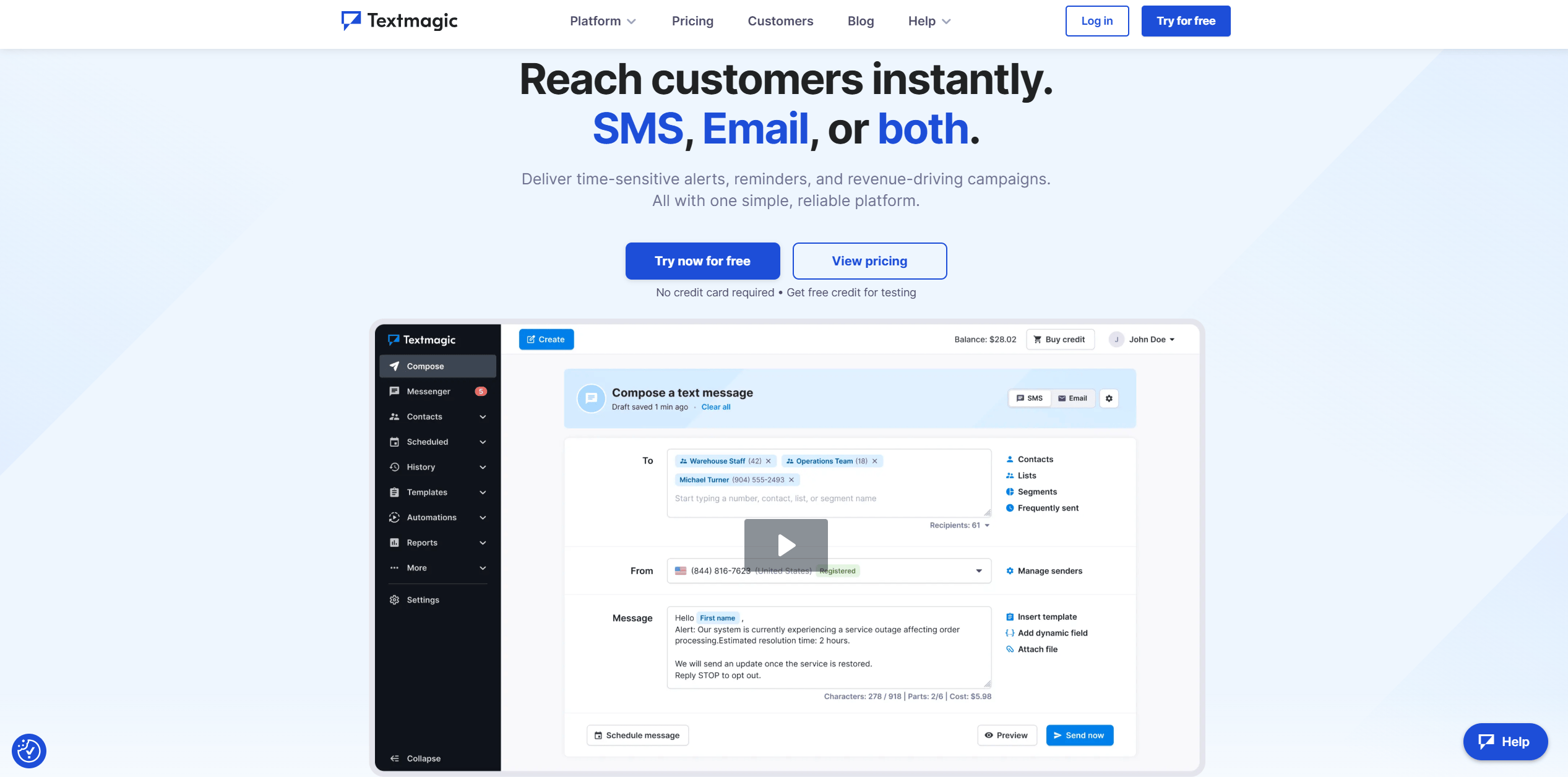
TextMagic is a reliable text marketing platform for businesses that don't want to be locked into a monthly subscription. It uses a pay-as-you-go model, making it perfect for startups or seasonal businesses that might send 2,000 texts one month and zero the next.
Features and compliance
- Pay-as-you-go credits: credits never expire, allowing for complete budget flexibility.
- Email-to-SMS: allows you to send and receive texts directly through your existing email client.
- Two-way chat: a simple, functional web interface for responding to customers.
Pros
- No monthly account fees or setup costs.
- Very easy to set up for basic use cases (reminders, alerts).
Cons
- Lacks advanced automation and segmentation.
- No volume discounts—the price per message remains the same regardless of scale.
Pricing
$0.049 per SMS (US). Requires a $10/month fee for a dedicated toll-free number.
6. Postscript
Best for: Shopify power-users focused on ROI.
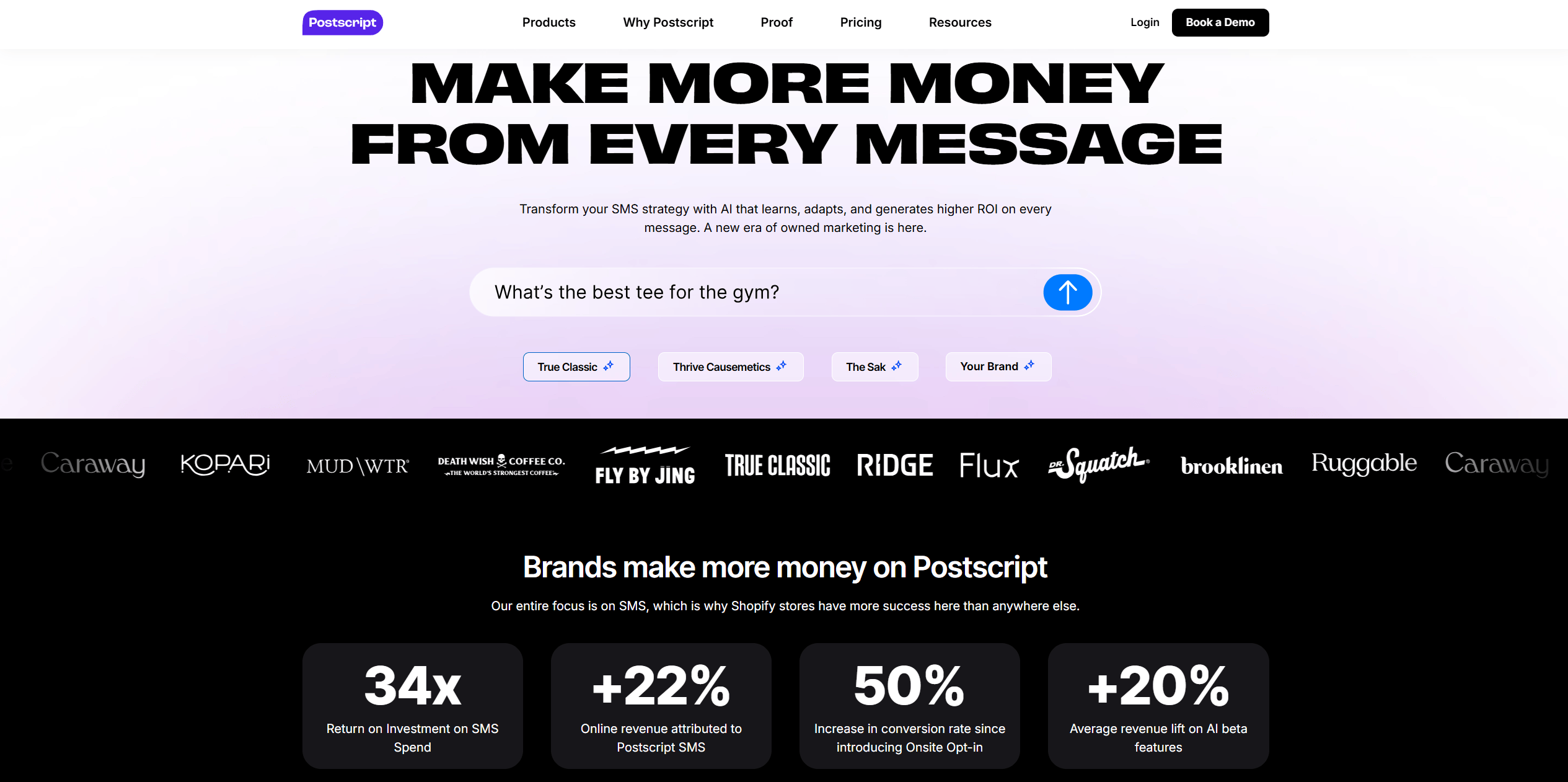
Postscript is a native Shopify application that specializes in "revenue-per-text." It is built entirely around the Shopify ecosystem, allowing for incredibly tight integration with store data. If your business lives and dies by its Shopify store, Postscript offers the most specialized toolset for that environment.
Features and compliance
- Shopify native data sync: real-time triggers based on specific product tags and customer tags.
- Safe sending: automatically pauses campaigns for customers who have recently received a text.
- Direct short code options: facilitates high-speed delivery for large flash sales.
Pros
- Extremely focused on e-commerce ROI.
- "Free to install" model allows you to test the waters with low risk.
Cons
- Limited use for businesses not on Shopify.
- The "Professional" features (like API access) are gated behind higher monthly plans.
Pricing
Starter plan is $0/month (with a $49/month minimum spend on messages). Growth and Professional plans range from $100 to $500/month.
7. SlickText
Best for: loyalty programs and local retail.
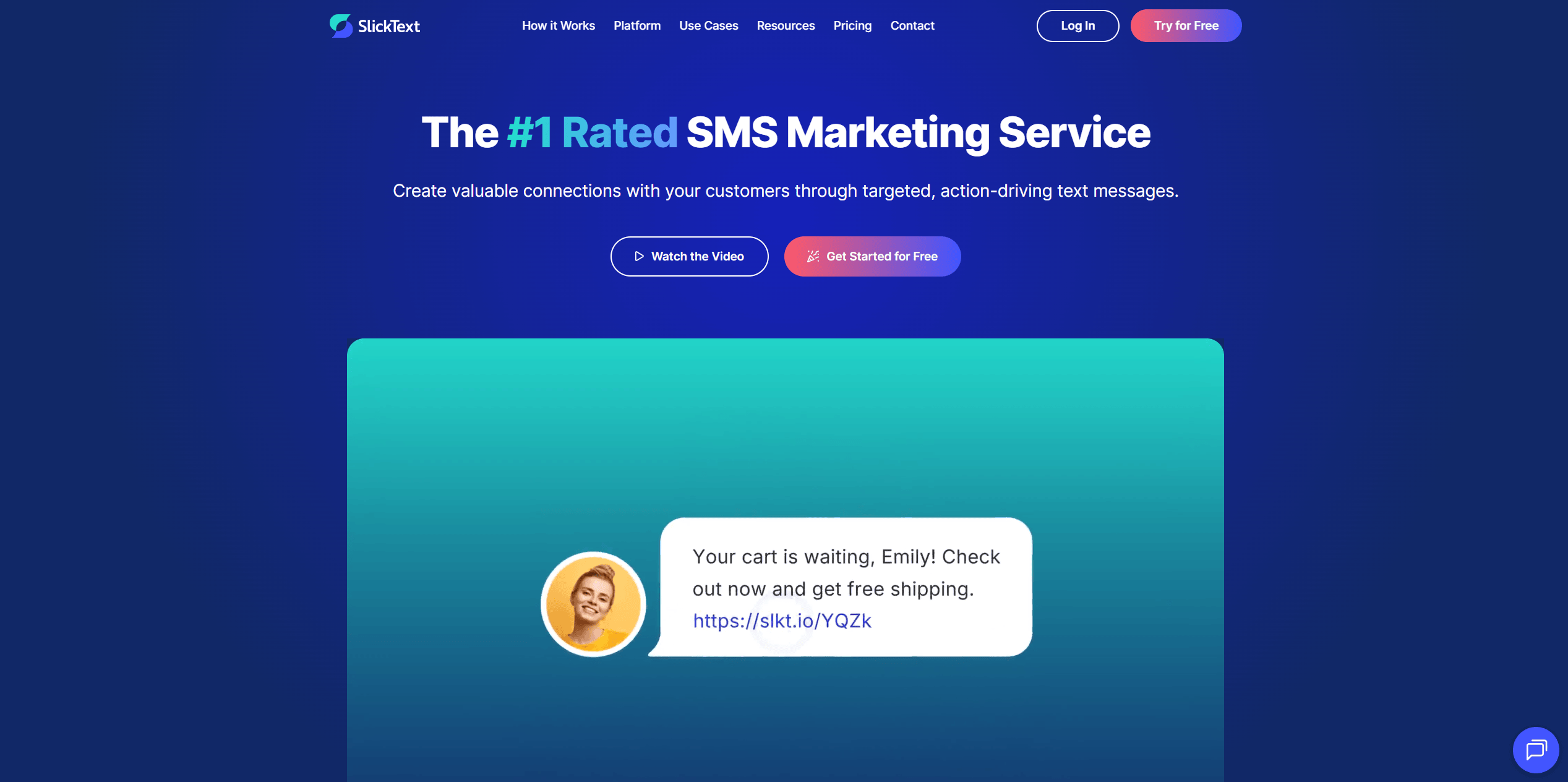
SlickText is highly regarded for its list-building features, such as "Text-to-Join" keywords and automated loyalty programs. It provides a user-friendly way for local businesses (gyms, restaurants, boutiques) to build a recurring customer base through simple, high-value interactions.
Features and compliance
- Text-to-win/survey: interactive features to engage customers and collect data.
- Automated drip campaigns: set-and-forget sequences for new subscribers.
- Inbox collaboration: shared access for staff to manage customer queries.
Pros
- High focus on subscriber growth and "fun" engagement features.
- Flexible plans that are easy to pause or upgrade.
Cons
- The interface can feel slightly dated compared to modern SaaS like Salesmessage.
- Managing multiple "textgroups" can become cumbersome for complex businesses.
Pricing
Starts at $29/month for 500 texts and 2 keywords.
8. EZ Texting
Best for: quick start and template-driven marketing.
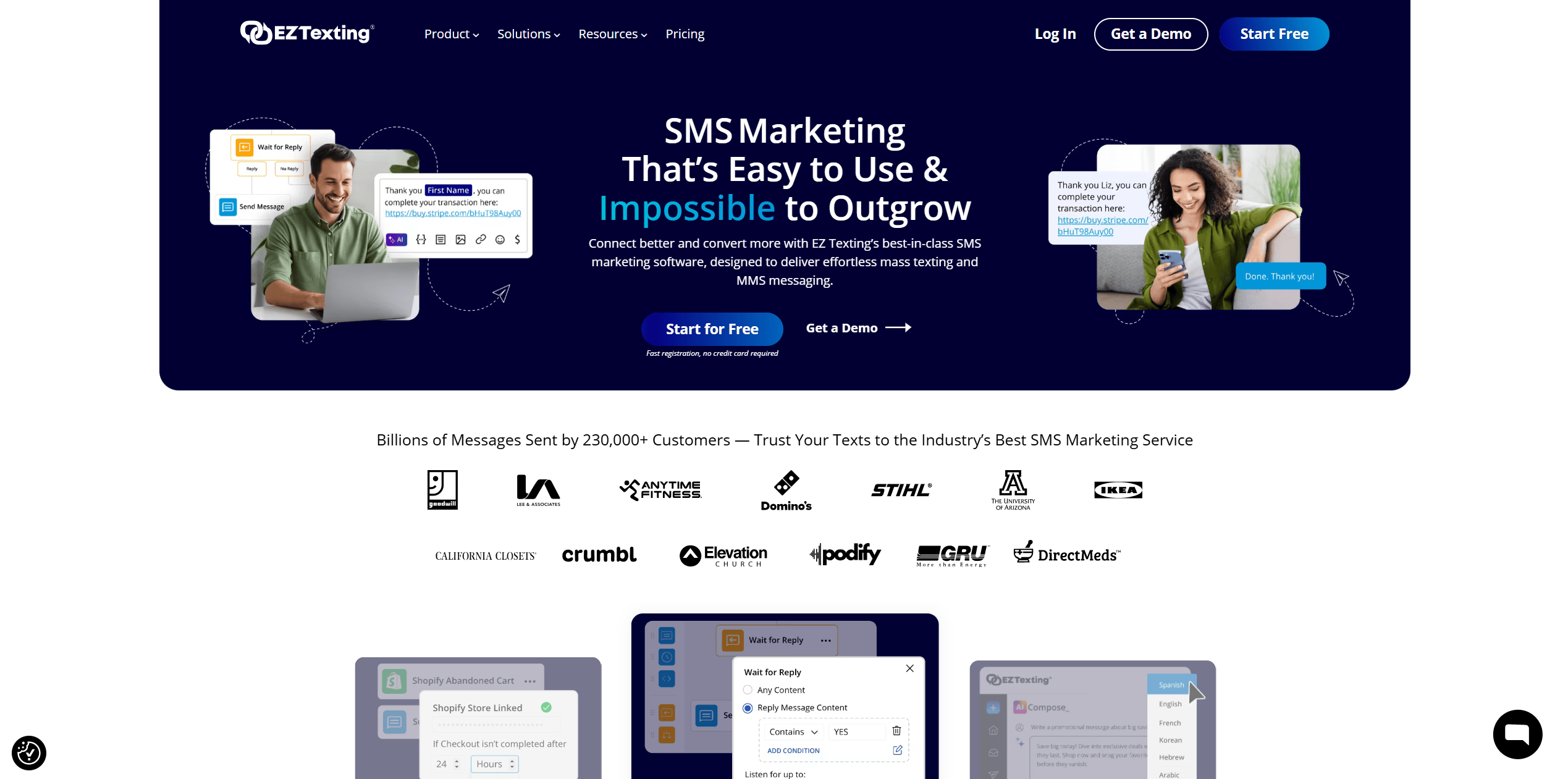
EZ Texting is designed for the small business owner who doesn't have time to be a marketing expert. With a massive library of templates and a very straightforward setup process, it allows businesses to get their first campaign live in under an hour.
Features and compliance
- SMS template library: pre-written copy for dozens of industries.
- RCS support: early access to next-gen messaging features for verified senders.
- 10DLC and toll-free options: clear paths for carrier-approved numbering.
Pros
- Very simple interface with a minimal learning curve.
- Includes image editing tools within the platform.
Cons
- Can become expensive if you exceed your monthly credit limit.
- Pricing for additional user seats can be confusing.
Pricing
Starts at $20/month (billed annually) for 500 credits.
9. ClickSend
Best for: global multi-channel communication.
ClickSend is a technical powerhouse that offers SMS, Voice, Email, and even Fax within a single platform. It is a favorite for businesses that need to reach a global audience across multiple channels using a unified API.
Features and compliance
- Multi-channel API: robust developer tools for integrating SMS into proprietary software.
- Global reach: direct carrier routes to over 200 countries.
- Free inbound messages: you only pay for the messages you send.
Pros
- No monthly fees — truly pay-as-you-go.
- Reliable delivery for transactional alerts and international messaging.
Cons
- The interface is more utilitarian/technical than "marketing-friendly."
- Setup for 10DLC compliance requires more manual effort than competitors.
Pricing
Pay-as-you-go. US rates start at approximately $0.0226/SMS (decreases with high volume).
10. Twilio
Best for: custom solutions and proprietary tech stacks.
Twilio is not a "marketing app" in the traditional sense; it is an infrastructure-as-a-service provider. It is the engine that powers many of the other apps on this list. Twilio is the best choice for businesses that want to build a completely custom, proprietary SMS workflow from scratch. However, it requires a development team to implement and maintain.
Features and compliance
- Unrivaled API flexibility: complete control over every aspect of message delivery.
- Lowest market rates: you pay the "wholesale" price for messages.
- Comprehensive compliance APIs: dedicated tools for managing 10DLC and global regulations.
Pros
- Infinite scalability and customization.
- The most cost-effective option for high-volume, automated messaging.
Cons
- No user interface for marketers; requires coding.
- Can be technically overwhelming for SMBs without a dedicated engineering partner.
Pricing
Pay-as-you-go. Starts at roughly $0.0083/SMS.
How to choose the best text marketing software for your business
There are a lot of factors that determine the best sms marketing software for small businesses. In a market where carriers are increasingly aggressive with filtering, your choice of platform directly impacts your deliverability, compliance risk, and overall ROI.
To find a solution that offers real value without the bloat, evaluate your candidates against these five critical pillars:
1. Regulatory compliance and 10DLC registration
Compliance isn't just a legal hurdle; it is a technical requirement for deliverability. Any reputable sms marketing platform must facilitate 10DLC (10-Digit Long Code) registration through The Campaign Registry. This ensures your brand is vetted by carriers, and that helps your not be flagged as spam.
Beyond 10DLC, the software should offer built-in TCPA and GDPR guardrails, such as automated "STOP" opt-out handling and double opt-in workflows.
2. Deep integration and data continuity
Standalone apps create data silos. The best sms marketing software acts as an extension of your existing digital infrastructure. At a minimum, it should offer native integrations with:
- CRMs: Salesforce, HubSpot, or Pipedrive for lead management.
- E-commerce: Shopify or Magento for automated abandoned cart and order updates.
- Scheduling: tools like Calendly or Microsoft Bookings for appointment reminders.
Look for a platform that offers a robust API for custom triggers, but also provides a "multi-surface" experience — including a web interface, a mobile app for on-the-go replies, and even a Chrome extension for texting directly from your browser.
3. Collaboration and shared inboxes
SMS is increasingly becoming a two-way conversation tool rather than a one-way broadcast channel. For SMBs, this requires features that support team collaboration:
- Shared inboxes: allowing support and sales teams to manage text chains together.
- Internal notes & tagging: adding context to conversations without the customer seeing it.
- Contact segmentation: using tags to trigger personalized, automated responses or surveys.
4. Rich media and next-gen messaging (RCS)
Today, standard SMS may be quite limited for marketing purposes. The platform that supports "Rich Communication Services" (RCS) enables you to send more than just plain text — think images, GIFs, booking links, and mobile wallet passes.
These "rich snippets" significantly increase engagement rates, as they provide a more interactive, app-like experience within the native messaging app.
5. Scalability without the "success tax"
Many platforms look affordable at low volumes but become prohibitively expensive as your contact list grows. Look for a transparent pricing model that doesn't penalize you for scaling.
The software should also remain stable and cost-effective, no matter if you’re handling a small batch of direct client communications or massive seasonal "mass send" campaigns.
6. The technical flexibility hint
In our experience consulting with software companies and SMBs, we often find that "off-the-shelf" SaaS gets you 90% of the way there. However, if a platform lacks a specific integration or a unique workflow your business requires, you don't necessarily need to switch platforms. Often, the better path is customizing the platform via its API or augmenting your team with technical expertise to build the "missing link" between your SMS tool and your proprietary backend.
Beyond the dashboard: when SaaS reaches its limits
Even the best sms marketing software has a "ceiling." For many small businesses, the frustration doesn't stem from a lack of features, but from a lack of flexibility.
You may find that while a platform is excellent for standard broadcasts, but then have trouble trying to implement a proprietary workflow or a non-standard integration.
This "SaaS gap" usually manifests in three specific technical roadblocks:
- Rigid operational workflows: most platforms are built to fit the general use cases. If your business requires unique logic — such as multi-step approvals for regulated industries or complex, event-driven triggers based on IoT data — the solutions often can't accommodate it.
- Data silos and integration depth: "native" integrations are frequently superficial. They might sync a name and an email, but they often fail to pull in the deep, proprietary data points sitting in your custom ERP or legacy database. Without this data, your sms marketing platform stays disconnected from your actual business intelligence.
- The need for custom front-ends: for some organizations, the goal isn't to log into another dashboard. It’s to bring SMS capabilities directly into their own internal tools or customer-facing apps. This requires building custom layers on top of robust APIs like Twilio or Salesmessage.
Optimizing your stack through technical partnership
When a SaaS reaches its limits, the solution isn't always to switch providers and endure another migration. Often, the most cost-effective path is to improve the way your existing tools communicate.
This is where partnering with a software vendor provides tangible value. With the right expertise you can revamp the architectural "connective tissue" of your marketing stack and transform a standard tool into a proprietary competitive advantage. This way, the software will reliably work for your business — not the other wy around.
Getting started: your SMS implementation checklist
Transitioning to a new sms marketing platform or launching your first campaign requires more than just a credit card and a contact list. To ensure a high ROI and avoid the common pitfalls of "SaaS fatigue," follow this technical implementation roadmap:
- Audit your data and compliance status: before selecting a vendor, verify how you collected your existing phone numbers. Ensure you have documented "express written consent" to avoid TCPA violations. This is also the time to prepare your 10DLC registration details (EIN, legal brand name, and use case).
- Map your integration requirements: don't just look for a dashboard; look for a bridge. Identify the "source of truth" for your customer data (e.g., HubSpot, Shopify, or a custom SQL database). The best sms marketing platform for you would be the one that requires the least amount of manual data entry to stay synced with your CRM.
- Define your migration strategy: if you are moving away from an existing tool, plan for a "warm-up" period. Carriers monitor sudden shifts in volume from new numbers.
- Run a pilot program: start with a high-value, low-volume use case — such as automated appointment reminders or a specific VIP discount code — to test deliverability and response rates before a full-scale "mass send."
Conclusion: finding a platform that evolves with you
In the rapidly shifting landscape of mobile communication, the top sms marketing software isn't a static product; it is a scalable piece of your infrastructure. Whether you choose a turnkey solution like Salesmessage for its deep CRM hooks or a developer-centric engine like Twilio for total control, your choice should be dictated by your technical capacity and long-term business goals.
Ultimately, the goal is to eliminate the friction between your brand and your customers. If you find that off-the-shelf software is leaving gaps in your workflow, or if your "legacy" systems are preventing you from adopting modern SMS strategies, it may be time to look beyond the subscription and toward a more customized approach.
The most successful SMBs don't just "buy" a solution — they build a stack that can adapt. Whether you need to augment your team for a complex migration or modernize your platform to handle 2026’s regulatory demands, the right technical foundation is what will turn a simple text message into a measurable business asset.


.png)


